Cyprus Field Trip
Day 5 - 23 March 2015
The aim of the day was to cover the Mamonia Terrane Lithologies and visit two Archaeological sites, (time precluded study of Miocene sediments) between Limassol and Paphos to the west.
The day dawned a little overcast, mainly because of sand in the atmosphere from the Sahara. Our “flight” commenced at 9.04hrs with a short flight time of 35 minutes to Kourion, a famous Greek –Roman archaeological site. On the journey Paul recapped our learning so far and introduced us to the history of the rocks of the southern shores. The ophiolite in Cyprus is relatively unaltered. The spreading ridge axes are today aligned north – south so it has been rotated through 90 degrees since its inception, when the subduction zone between Africa and Eurasia was orientated east – west. Going back earlier than 100million years to the Triassic 230 – 240 million years saw the formation of Pangea, which in late Permian divided in to Eurasia and Gondwanaland and a spreading ridge. The Neotethyan Ocean (Mediterannean today) formed with pillow lavas, dykes and more intrusive rocks typical of oceanic crust. On the continental margins there were shelf sediments – limestones, sandstones and corals. In the Jurassic, 140 – 150 million years, the tectonic regime changed to convergence and the “Alpine Orogeny”. The Iberian massif drifted north to collide with Eurasia and formed the Pyrenees running east – west. The convergence zone wasn’t an even margin. An easterly “lump” – the Arabian promontory collided with the end of the Eurasian Plate and so subduction stopped. The collision caused tectonic displacement of material southwards so that ophiolites are found in South Turkey and Oman as it slid southwards. The Cyprus part was further west and escaped this displacement, but a slab became dislocated and formed a microplate which underwent anticlockwise rotation for 40 million years and so moved through 90 degrees. This induced torque was caused by the north moving faster than Africa. The east – west subduction zone became north – south and a spreading ridge. The edge of the Troodos microplate interacted with an earlier exotic ocean crust of the Neotethys to form the Mamonia Terrane, all happening at an abyssal depth of 4km. Neotethys to form the Mamonia Terrane, all happening at an abyssal depth of 4km.
Site 1 Kourian
This was an ancient city originally populated by Greek Pelopennesus immigrants in 1600BC but later occupied by the Romans. We visited the Greco – Roman Amphitheatre for a group photograph on the steps. (This procedure took 30 minutes!) It was probably built towards the end of the 2nd century BC, but it suffered repeated damage from intense earthquakes, which led to a series of restorations in the 1st, 2nd and 3rd centuries AD. It was destroyed and completely abandoned in the 4th century AD. The existing theatre is for the most part a modern reconstruction. We also visited the House of Eustolios, which consisted of a complex of baths and a number of rooms with superb 5th century AD mosaic floors: it was once a private Roman villa before it became a public recreation centre during the Early Christian period. It follows the well-known architectural type of a peristyle Roman villa. Inscriptions show that Eustolius had connections with paganism and the new religion of Christianity. At the entrance to the site we saw outcrops of the Pakhna Formation – where it had moved from the pelagic to reef development in shallowing seas, and in the upper part it was very fossiliferous- of Neogene age, 12 – 15 million years. The Pakhna Formation indicated a significant phase of uplift of the Troodos region, as pelagic sedimentation was replaced by hemipelagites during continuing basin shallowing. The presence of reef limestones signified that for the first time the parts of the Troodos / Mamonia ocean floor had emerged to sufficiently shallow depths for reef formation. Building blocks of this material had been used in the construction of the villas.
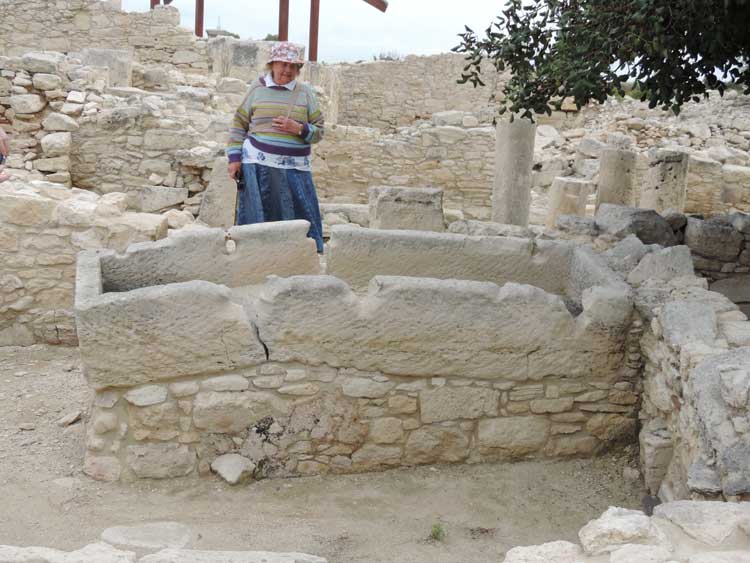
Broken stone water tank at Kourion.
We saw evidence of earthquake activity (365AD) in a broken stone water tank and of further 7th century activity, all indications of on-going convergence as slow subduction continues under the Cyprus Arc today where the African Plate subducts beneath the Anatolian Plate.
Site 2. Petra tou Romiou viewpoint.
We looked down upon Aphrodite’s Rock, which stood out as a large white rock from the surrounding brown coloured pillow lavas. The pillow lavas were formed in the late Triassic in a rifted small ocean basin floor within Neotethys to form the oldest member of the Mamonia Complex Dhiarizos Group. Fringing carbonate atolls developed in the basin to form the rock of which the Aphrodites Rock remnant is made. An alternative! – “Petra tou Romiou” actually means “the Rock of Romios” – named after the Byzantine folk hero Romios, who used this and other large blocks and boulders to hurl at pirates.

Viewpoint looking down on Aphrodite's Rock.
On the landward side of the road the scene was dominated by chalks, marly chalks and marls of the Lefkara and Pakna Formations – clearly unstable and failing in places: they rest unconformably on Mamonia and Kannaviou Formations.
Site 3. Petra tou Romiou.
a). We studied Aphrodites Rock on the beach. It is a giant clast or “olistolith” – a component of an olistostrome. It had been in a clay matrix of Moni radioarites, which has been eroded away to leave the rock, which itself consists of a conglomerate of limestones with remnants of coral at the top – of late Triassic age.
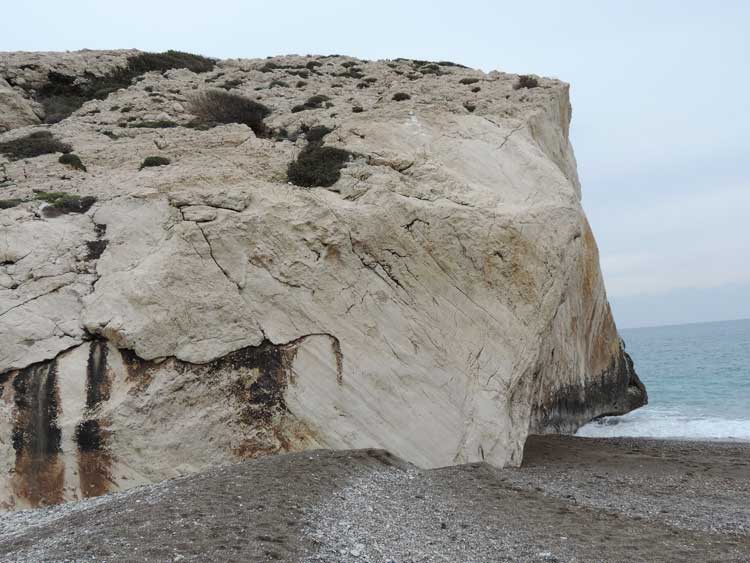
Slickenslides at Aphrodite's Rock.
How did this olistolith get here?
The Mamonia Terrane itself is an allochthonous assemblage of Triassic to Jurassic age ocean floor volcanics and mainly pelagic sediments (the Dhiarizos Group) and an assemblage of mainly continental margin deposits, (the Ayios Photios Group) of similar age. The Terrane unit was tectonically emplaced alongside slivers of the Troodos Terrane during microplate rotation in the late Cretaceous. Ocean floor sediments formed on top of the Mamonia Terrane. One such formation involved exotic blocks within bentonitic clays and is known as the Moni Formation. The blocks are olistoliths of Mamonia and Troodos lithologies, some of which are massive. (1km in size). Olistolith emplacement took place in intra Maastrichian time approximately 65 million years ago. The ocean basin floor and passive continental margin lithologies are believed to have collapsed into, and become accreted to the trench and subducted northwards. Once the Troodos micro plate rotation and intra–oceanic slicing began the accreted olistoliths were incorporated onto the rotating plate and entrained within the existing sea floor clay-radiolarite sediments as the major Mamonia crust was juztaposed along arcuate strike-slip faults with the Troodos complex. Aphrodites Rock’s slickenslides attest to the shearing and thrusting it experienced in the strike-slip fault zone. Subsequent uplift exposed the Moni Formation and Aphrodite's Rock was more recently left isolated after the softer surrounding bentonitic clay matrix was eroded away. The adjacent pillow lavas are also part of the olistolith.
“In ancient times, Cyprus was known as the birthplace of Aphrodite and the centre of her worship, though worship of Aphrodite was widely spread throughout the Mediterranean region. Even today, Cyprus is called the island of Aphrodite, goddess of love, beauty, and fertility. Legend associates the name “Aphrodite” with her birth of the sea-foam as the Greek word (aphros) means “foam.” Hesiod’s description of Aphrodite’s birth begins as follows: Aphrodite was born out of the sea foam when Uranus was cut by a sickle and fell into the sea, attacked by his son Cronus. The water began bubbling and foaming in the spot where Uranus had plunged into the sea. Suddenly, the most beautiful maiden came up from the foam an appeared on the surface. At first the waves gently carried her toward Cythera but Zephyrus, the western wind, ultimately guided the waves to the shores of Paphos, Cyprus. “
Roger Smith read Shelley’s poem “The Birth of Aphrodite”.
The rock has indeed emerged from the subduction zone but so has the whole island of Cyprus emerged from the sea! How clever the Greeks were!!
b). We crossed the road above the beach to view the low cliffs of gently dipping bedded red coloured radiolarites. When conditions are right, the radiolaria form cherts, very high in silicates. Serpentinite, pillow lavas and cherts are all indicators of deep ocean volcanics and pelagic sediments and these are part of the “Mamonian Terrane”, which was tectonically incorporated during Triassic times as an allochthonous assemblage ie unaltered. They were deposited on top of the earlier pillow lavas on the Neotethyan ocean floor. These beds are in situ and not redeposited olistrostromes.
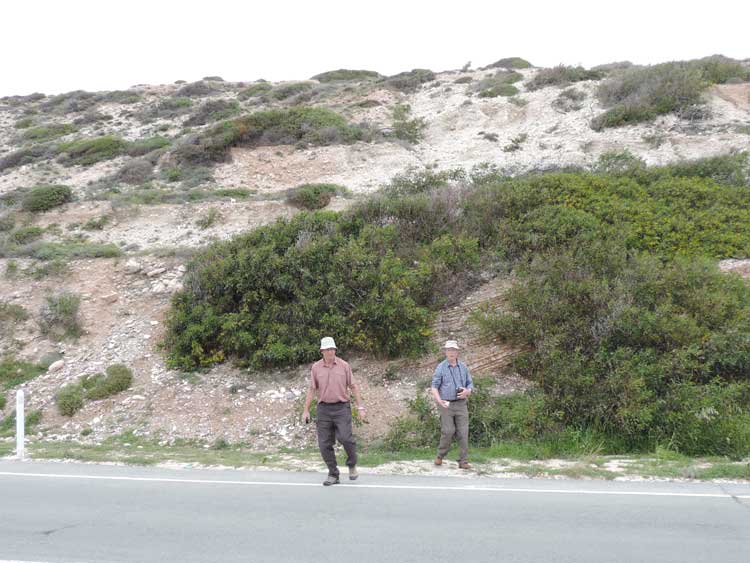
Well bedded radiolarites forming chert, on road site opposite to Aphrodite's Rock.
4. Paphos.
We drove on west to Paphos for a very protracted lunch stop at the Pelikan waterfront taverna restaurant. The service was very slow – so much so that it curtailed some of the afternoon visits. We arrived at 1pm and left at 2.30pm!

Lunch at the Pelican restaurant, Pathos.
World Heritage Archaeological Site of Kato Paphos.
This comprises a large group of Roman dwellings in the ancient city of Paphos, many of them well restored. There are also less well-restored town dwellings, temples, streets and an excellent amphitheatre. Paphos was the capital of Cyprus in Hellenistic and Roman times.
Some of the group had a short one-hour guided tour of a small part of the site concentrating on the Roman House of Dionysos. This was a luxurious house destroyed in the 4th century AD earthquake. It had 35 rooms with marvellous mosaics. The mosaic decorations and the mythological compositions are the main characteristics of this restored Roman villa, dating back to the 2nd century AD. The house is named “House of Dionysos” thanks to the many depictions of Dionysos, the god of wine. The house most probably belonged to a member of the ruling Roman class or to a wealthy citizen of Paphos.

Mosaics at the Roman House of Dionysos, Kato Pathos.
We drove straight back to the hotel as it was late and the return journey was approximately 60kms.
Unfortunately we missed seeing most of the evidence of the Miocene sediments. 5 million years ago the Tethyan Ocean dried out with 3 kms depth of water lost. This was because of increased evaporation under an arid climate and a land bridge develop around the Straights of Gibraltar, which cut off replenishment from the Atlantic Ocean. A considerable thickness of salt deposits formed which resulted in significant beds of evaporitic selenitic gypsum deposits. On our return journey we passed through a road cutting through Axylou, which showed glistening crystals – the Kalavassos Formation evaportites of Messinian age. We did not stop to see the exposure of gypsum crystals (many over 1m in length) at Amargeti.